
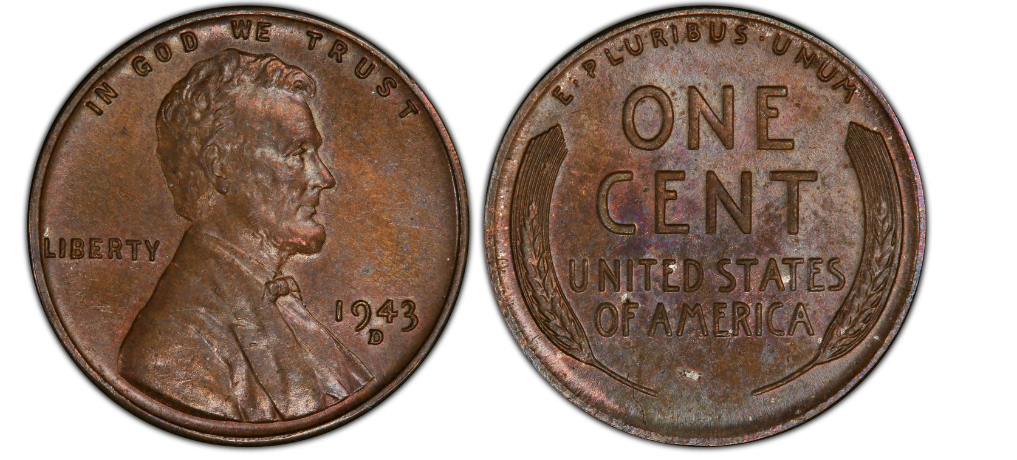
The American penny, in various forms, has been a unit of currency since 1793. But its long run may be coming to an end. The US government hasn’t yet made definite plans to discontinue the penny, but there is an ongoing debate over whether or not it should be eliminated. The penny costs more to produce than it’s worth. The US Mint estimates that each penny costs 2.4 cents to produce, making it a losing proposition for each coin. It’s rarely used in transactions any more, and represents a burden on the economy. So it’s possible that the lowly penny will be discontinued in the next few years. On the other hand, a rare and possibly unique Lincoln cent sold at auction for $1.7 million in 2010. Dated 1943 and struck at the Denver Mint, accidentally on a bronze planchet. In that year, zinc coated steel was used instead of copper, to preserve the copper for the World War II effort. But somebody goofed and a small number of coins were struck on bronze planchets left over from 1942. About 20 such coins are believed to have been minted in San Francisco and Philadelphia. But this is the only one known to have been produced in Denver.
When I was just a young boy of seven or eight years old, back in the 1950s, I began collecting coins and paper currency. One of our neighbors was an airline pilot, and frequently he would bring me pocketfuls of coins from places he had visited. Places I had never heard of; Somaliland, Lichtenstein, Burma. My grandmother gave me paper currency from her native Lithuania.
Since ancient times, people have been using currency as a medium of exchange for needed goods. Often the exchange medium would be other desirable goods, such as tools, jewelry, fabrics or sea shells. The first metal coins began to appear around 600 BC. The earliest known such coin is the Lydian lion coin, a one-sided coin showing an imprint of a lion and bull, made of electrum, an alloy of gold and silver. In today’s market, these coins can be worth $1200 to $60,000 USD.
The key features in identifying and evaluating coins are size, color, alloy, weight, shape, region of origin, date imprints, and other inscriptions, and condition. Age can be a factor in rarity, but it often isn’t the primary determinant of value. For example, an American double eagle, minted in 1933, not a particularly early date, sold for a world record of about $19 million USD.
HOW TO EVALUATE COINS
If you wish to have coins or currency evaluated, www.siscoantiquesappraisals.com can help. We can analyze your coin, and provide you an evaluation within 48 business hours.
THIRD PARTY GRADING
If you are considering purchase of a coin, getting it graded by an independent third party might be a good move. This would establish the authenticity and the marketable condition of the coin. There are four well recognized grading services that can help with this.
- Numismatic Guaranty Corporation (NGS)
- American Numismatic Association Certification Service (ANACS)
- Professional Coin Grading Service (PCGS)
- Independent Coin Grades (ICG)
For coins of high value, it can be very important to know its history before you purchase it. So careful research can often yield important results.
Here’s how Sisco Antiques Appraisals can help you. Click on this link to get started.
https://siscoantiquesappraisals.com/appraisal/

Leave a Reply